Editor’s note: This guest post was written by Wheatmark author Judy Ikels, author of Death in Wartime China: A Daughter’s Discovery. In it, she shares what she has learned about finding readers and creating book-marketing opportunities after publication.
Death in Wartime China: A Daughter’s Discovery was published May 6, 2022, through Wheatmark. It was a successful writing and editing project under the professional guidance of Wheatmark project manager Lori Conser. Feeling a great sense of accomplishment and palpable relief on completion, I made a comment to Lori along the lines of, “Now, what?” She was quick to point out that my work to market the book was just beginning and could take me as far as my interest and energy would allow.
My primary motive in writing was to honor my father, 2nd Lt. William H. Wallace, Jr., a heroic young pilot who died in WWII China in 1944. I had a personal interest in telling his story and connecting with readers.
Knowing I needed help, I started with a media/publicity firm. They kick-started introductions that led to several radio interviews. Those early interviews helped me refine the oral story. The experience also revealed that people were interested in the writing of the story and how I felt about it. These angles surprised me; I had to plan responses.
Eventually, I realized my role as the “best spokesperson” to get people’s interest. Borrowing skills from my former job coaching portfolio, I whittled the story down to a concise “one-minute drill.” What would you say about your book if you only had a minute to describe it?
It turns out, people are quite predictable. Often when you meet a new person, especially in the United States, they will ask, “What do you do?” My response: “I retired from the Department of State, and I wrote a book.” Guaranteed, the person will follow with, “What’s your book about?”
Here, keep it short. Practice your sentence. For example, say the name of your book: “Death in Wartime China is about my birth father, who flew with the famous Flying Tigers defending the Chinese in WWII and died before I was born. I went to China and learned so much about him and the historical alliance of the U.S. and China.”
Many people are surprised to hear about this forgotten history.
Then, I often ask, “Did anyone in your family serve in WWII or other conflicts?”
Well, you get the idea. Unless you are a recognizable author, no one will know you have written a book. It is helpful to generate a connection with others on your topic, whatever it is. Also, and this was hard for me, you have to keep it short. After months or years of research, you are tempted to want to tell it all. But don’t. It will overwhelm, if not bore, your potential reader.
I printed postcards with the cover of my book on one side and a short blurb, purchasing information, and website on the back. My regular calling cards also include book information. When approaching libraries or other institutions, it is helpful to have professional materials to leave behind. You never know who will follow up, or where readers will appear. I recently heard from a person who read my book based on a card I gave him during a conversation in a nail salon.
My book journey has been greatly enhanced by contacting “natural audiences.” The Washington, DC, area has a large and well-connected population of Chinese Americans who facilitated many introductions and invitations. A partial list of events includes the Chinese Writers Association, Tea4Soul, an educational and social group, Chinese American Women of Virginia, Maryland, and DC, and a famous Smithsonian calligrapher. The list goes on. Book clubs, libraries, writers’ groups, senior living facilities, and religious groups can provide venues.
I have also found that the same book talk can be framed differently depending on the audience or occasion. Around Memorial Day, Father’s Day, or Veterans Day, the themes of service, sacrifice, and family loss may be especially meaningful. In a church community, I found myself focusing more on the spiritual aspects of the story. Other audiences are interested in the long-term effects of war loss on families, including their own.
Friends also put me in touch with well-known writers. I was thrilled when John Kelly, formerly of The Washington Post, dedicated his Memorial Day column in 2023 to my book.
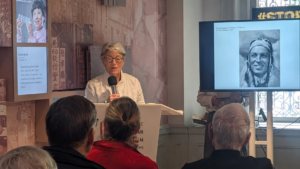
For me, the happiest book talk of late came when the Chinese American Museum in Washington, DC, hosted a spring exhibit, “Soaring for Freedom: The Flying Tigers Legacy.” Through the help of a Chinese friend, I met a museum director, took her a copy of my book, and offered to support the exhibit in any way she suggested. This contact resulted in a standing-room-only book talk at the museum on April 25. It was a great honor for me. From that event, two more invitations have developed.
Four years out, the book journey continues.
Judy Ikels can be reached at IkelsLJ@aol.com. More information about Death in Wartime China: A Daughter’s Discovery is available at deathinwartimechina.com.